Capilia Longa™ Stamcellen

Stem cells and hair growth: what does the science actually say?
Stem cells are often called the new weapon against hair loss. But what exactly are stem cells, and what does the research really show? In this article we line up the studies. No sales pitch, just the facts.
After this article you'll know:
- →What stem cells are and what they do for your hair.
- →What the independent PubMed studies say about them.
- →What the clinical study on Capilia Longa shows.
The topic has grown so big that even De Telegraaf wrote about it.

First: what are stem cells?
Stem cells are the building blocks of your body. They are cells that haven't specialized yet. They can develop into all kinds of cells, and they can trigger other cells to repair and grow.
That's interesting for your hair. Because with hair loss, your follicles don't die straight away. First they shrink and go dormant. A dormant follicle produces little to no hair.
Put simply: stem cells can wake those dormant follicles back up. That allows new hair to grow again.
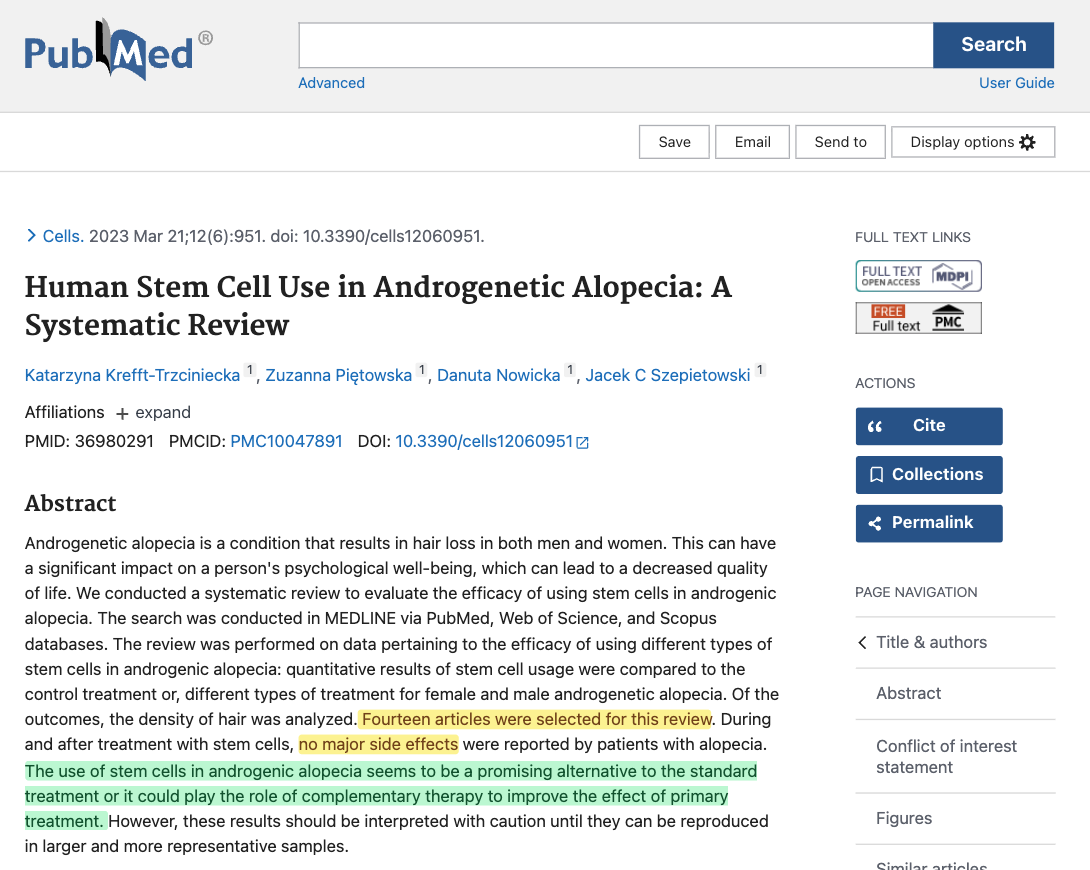
But does that actually work? Two large scientific reviews looked into it.
👉 Swipe for both studies
 🔍 Enlarge
Study 1: Krefft-Trzciniecka et al., Cells (2023). Tap to enlarge.
 🔍 Enlarge
Study 2: Talebzadeh & Talebzadeh, Cureus (2023). Tap to enlarge.
These reviews are published in the National Library of Medicine, the largest medical library in the world. Only research that has been checked by other scientists gets included there. The conclusion from both reviews is clear:
- ✓Stem cells are a promising alternative to the FDA-approved medications (Finasteride and Minoxidil).
- ✓Stem cells can also be an addition if you already use Minoxidil or Finasteride.
- ✓Stem cells wake dormant follicles back up and support new hair growth.
- ✓No serious side effects reported.
From principle to practice: the problem with stem cells
So the science shows that stem cells can work. But there's a practical catch.
Human stem cells, like a treatment at a clinic, are extremely expensive. And hair loss isn't something you address once. It's something you keep up every day. Going to a clinic once a month is therefore both costly and impractical.
So the logical question is: does a stem cell ingredient exist that you can simply use at home?
Capilia Longa: a stem cell extract for home use
This is where Capilia Longa comes in.
Capilia Longa is a patented stem cell extract from the turmeric plant. It's made by the Spanish lab Vytrus Biotech in Barcelona and has won several awards in the cosmetics industry. Unlike an injection at the doctor, you simply apply it to your scalp as a serum.
Most importantly: Capilia Longa has been clinically studied. That study was carried out by the Center of Technological Dermatology in Barcelona. In that research it was even compared to Minoxidil.
Capilia Longa: the clinical data, explained.
What does the clinical study say?
The study looked at three claims. We go through them one by one, with the matching graph from the research.
1. 57% less hair loss

After 150 days of use, hair loss dropped by 57%.
True per the study: 57% less hair loss after 150 days.2. On average 13,500 new hairs

On average, users in the study saw 13,500 new hairs.
True per the study: on average 13,500 new hairs.3. Faster than Minoxidil, without the known side effects

The study measured IGF-1 production. IGF-1 is a growth signal for your follicles. Capilia Longa reached +115% after 24 hours. Minoxidil reached 91%, and only after 48 hours (twice as long).
Per the study, Capilia Longa activates the follicles faster, without the known side effects of Minoxidil.Source: clinical study, Center of Technological Dermatology, Barcelona.
One thing to remember
Stem cells wake dormant follicles back up. That matters. But for most men, hair loss is also linked to the hormone DHT, which makes follicles shrink.
Stem cells don't address that hormone. That's why researchers increasingly look at a combination: stem cells that activate the follicles, alongside ingredients that tackle DHT. The one doesn't rule out the other.
Sources
This article is based on independent research from the National Library of Medicine, clinical data on the ingredient Capilia Longa, and official EU regulation.
- Krefft-Trzciniecka K. et al. (2023), "Human Stem Cell Use in Androgenetic Alopecia: A Systematic Review." Cells. Review: stem cells promising for hair loss, no serious side effects. DOI: 10.3390/cells12060951
- Talebzadeh A.T. & Talebzadeh N. (2023), "Stem Cell Applications in Human Hair Growth: A Literature Review." Cureus. Stem cells can grow new follicles and reactivate dormant follicles. DOI: 10.7759/cureus.37439
- Capilia Longa™ (Vytrus Biotech) — clinical study carried out by the Center of Technological Dermatology, Barcelona.
- Pumthong G. et al. (2011), "Curcuma aeruginosa, a novel botanically derived 5α-reductase inhibitor in the treatment of male-pattern baldness." Journal of Dermatological Treatment. DOI: 10.3109/09546634.2011.568470
- Androgenetic alopecia affects up to 80% of men; DHT is the primary hormonal factor.
- European Commission (2009), Regulation (EC) No 1223/2009 on cosmetic products.